
You’ve decided to ditch your ducted gas heater. Smart move. But now you’re facing a second decision: multi-head split system or ducted reverse cycle? The answer affects your comfort, your running costs — and the size of the VEU rebate applied to your install. Here’s the honest breakdown.
By Greentastic Pty LtdUpdated April 202610 min read
The short answer
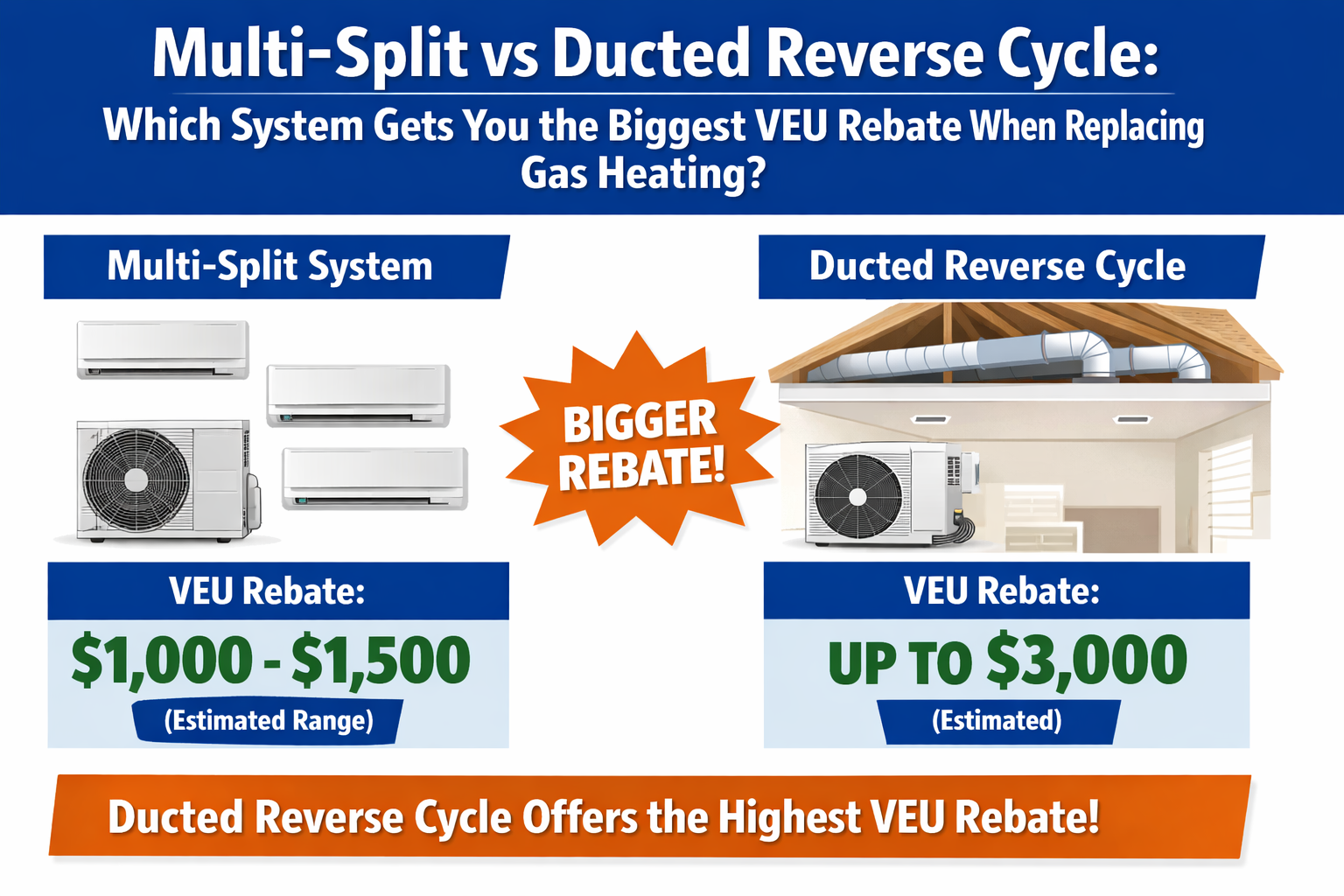
Both systems attract substantial VEU rebates when replacing a ducted gas heater — up to $5,530 upfront according to the Victorian Government’s official heating and cooling discounts page. The rebate amount is driven primarily by the greenhouse gas emissions your upgrade eliminates, not the system type itself. What differs is installation complexity, running costs, home suitability, and long-term comfort. This guide explains exactly how to choose — and how to claim every dollar you’re entitled to.
The Context
Why Melbourne Homeowners Are Making This Decision Right Now
The decision isn’t just financial — it’s being driven by a hard government deadline and structurally rising gas prices.
Melbourne has more ducted gas heaters per household than almost any other city in Australia. And in 2026, almost every one of them costs more to run than a modern reverse cycle system — and that gap is growing fast.
Gas prices have risen 40–50% in real terms since 2019. Victoria’s Bass Strait gas fields are in structural decline, leaving the state increasingly reliant on Queensland and imported LNG priced at international market rates. Energy analysts expect the upward trend to continue to 2030 and beyond.
On top of this, from 1 March 2027, gas heating systems in Victorian homes must be replaced with electric alternatives when they reach end-of-life. Homeowners who plan ahead — rather than waiting for a mid-winter breakdown — get to choose their system, compare quotes, and access the VEU rebate at maximum value. Those who wait face emergency replacement with no time to compare options.
Why the VEU rebate is highest right now
The VEU program calculates your discount based on the greenhouse gas emissions your upgrade eliminates. Replacing a ducted gas heater with a reverse cycle electric system is one of the largest single emissions reductions achievable in a home — which is exactly why it attracts the program’s highest rebate tier. Acting before the 2027 deadline also protects you from a rebate reduction if program settings are reviewed.
The Efficiency Case
Why Both Systems Beat Gas — Decisively
Before comparing the two electric options, it’s worth understanding why either one outperforms your existing gas heater by a large margin.
A ducted gas heater operates at roughly 85–92% efficiency — meaning about $0.88 of every $1 you spend on gas becomes useful heat, with the rest lost through flue exhaust. A modern reverse cycle air conditioner doesn’t generate heat at all — it moves it from outside air using refrigerant technology. That fundamental difference produces a Coefficient of Performance (COP) of 3.0 to 4.5, meaning $3.00–$4.50 of heating for every $1 of electricity consumed.
Ducted gas heater85–92% efficiency (COP ~0.9)
Burns gas to generate heat. Loses 8–15% through flue and ductwork. Vulnerable to rising gas tariffs.
Multi-head split system (reverse cycle)300–450% efficiency (COP 3.0–4.5)
Moves heat from outside air. Each kWh of electricity delivers 3–4.5x equivalent heat output. Zoned room control eliminates heating empty spaces.
Ducted reverse cycle (zoned)300–420% efficiency (COP 3.0–4.2)
Same refrigerant heat-pump technology. Whole-home distribution via ceiling ducts. Efficiency influenced by duct sealing and zoning quality.
Official Government Energy Data
For a medium 160m² Melbourne home, a 3.5-star multi-split reverse cycle costs approximately $90 per year to run. An unzoned 3-star ducted reverse cycle system costs approximately $125 per year for the same home — and a ducted gas heater considerably more at current gas tariffs. (Source: Sustainability Victoria energy cost data, updated December 2024.)
Modern inverter-driven reverse cycle systems are also rated to operate efficiently down to −15°C — well beyond anything Melbourne winters produce, which rarely drop below 3–5°C at night.
VEU Rebate Figures
The Actual Rebate Numbers — Sourced From energy.vic.gov.au
All figures below are drawn directly from the Victorian Government’s official VEU heating and cooling discounts page.
Replacing ducted gas heater
$5,530
Multi-head or ducted reverse cycle
Upfront VEU discount applied directly to your invoice. No forms for you to complete. Administered by Greentastic as your trusted provider.
+ Save up to $1,140/yr on bills
Replacing gas space heater
$1,610
Single or multi-head split system
Per-unit discount when replacing individual gas wall heaters. Multiple units in a single job can stack to increase total rebate value.
+ Save up to $460/yr on bills
Important: Minimum co-payment applies
From 1 February 2025, the Essential Services Commission requires a minimum customer contribution of $1,000 (inc. GST) for all multi-split and ducted reverse cycle systems. This is the minimum you pay — the VEU discount is applied on top of the full installed system cost and is reflected in your written quote. For systems under 10kW non-ducted, the minimum co-payment is $200.
The exact rebate value you receive depends on the system’s energy efficiency rating, the size of your home, the system’s kW capacity, and the current VEEC (Victorian Energy Efficiency Certificate) market price at the time of installation. Greentastic provides a fixed-price, itemised written quote showing the gross price, the VEU discount applied, and your net out-of-pocket cost — before you commit to anything.
The Comparison
Multi-Split vs Ducted: A Fact-Based Head-to-Head
Here is an honest, side-by-side comparison of the two systems across every factor that matters to Melbourne homeowners.
| Factor | Multi-head split system | Ducted reverse cycle |
|---|---|---|
| VEU rebate (gas heater replacement) | Up to $5,530 | Up to $5,530 |
| Annual bill saving (Victorian Govt figure) | Up to $1,140/yr | Up to $1,140/yr |
| Upfront installed cost (after rebate, typical Melbourne home) | $3,000–$8,000 | $6,000–$16,000 |
| Annual running cost — 160m² home | ~$90/yr (3.5 star) | ~$125/yr (3-star unzoned) |
| Installation time | 1–2 days | 2–3 days |
| Suitable for homes without existing ductwork | Yes — no ductwork needed | Requires accessible roof space and ductwork |
| Zoned room-by-room control | Yes — each head independent | Yes — with zoning kit (adds cost) |
| Aesthetics — visible indoor units | Wall-mounted units visible in each room | Concealed — ceiling vents only |
| Suitable for homes with existing ducts | Yes, but existing ducts unused | Yes — can reuse existing ductwork |
| Wi-Fi / smart app control | Yes — all Greentastic brands | Yes — all Greentastic brands |
| Payback period (after rebate) | 2–5 years | 4–8 years |
| 5-year VEU warranty (mandatory from March 2025) | Included | Included |
| Minimum co-payment (from Feb 2025) | $1,000 inc. GST | $1,000 inc. GST |
Rebate figures sourced from energy.vic.gov.au. Running cost data from Sustainability Victoria (December 2024). Installed costs are post-rebate indicative ranges for a typical Melbourne 3–4 bedroom home and vary by system size, brand, and site requirements.
Which Is Right for You?
Choosing By Home Type — An Honest Guide
The best system isn’t the most expensive or the one with the highest star rating — it’s the one that matches your home’s layout, your family’s habits, and your budget.
🏠
Older Melbourne home — no ducts
Weatherboard, brick veneer — 100–160m²
Multi-head split
No accessible roof space for ductwork makes multi-head the practical and cost-effective choice. A 3–4 head system covers all main living areas with independent zone control per room. Installation takes 1–2 days with minimal disruption.
🏡
Home with existing gas ducts
Brick or project home — 160–250m²
Either — assess first
If existing ductwork is in good condition and properly sealed, a ducted reverse cycle can reuse it and provide seamless whole-home comfort. If ductwork is old or poorly sealed, a multi-head split system may deliver better efficiency and lower running costs.
🏘️
Larger family home — 4+ bedrooms
220m²+ with multiple living zones
Ducted or multi-head
Ducted systems with zoning provide the highest comfort consistency across a large home. Multi-head systems offer individual room control and may be more efficient if rooms are used independently throughout the day. Budget and ductwork access guide the final call.
The one thing to check before deciding
Whether you’re leaning toward multi-head or ducted, the single most important step is a free in-home assessment. Greentastic’s specialists assess your roof space, existing infrastructure, room layout, and daily usage patterns before recommending a system. A poorly sized or wrongly specified system — regardless of how high its star rating — will deliver less comfort and fewer savings than a well-matched one.
Greentastic Tip: Higher efficiency = higher VEU rebate
Under the VEU program, higher-efficiency systems generate more Victorian Energy Efficiency Certificates (VEECs) — which translates directly to a larger upfront discount. When we quote you, we always show you the comparison between standard and high-efficiency models, including the difference in rebate value, so you can make an informed choice on the day.
VEU-Approved Brands
Which Brands Does Greentastic Install?
All systems supplied and installed by Greentastic are on the VEU approved product register, meet Greenhouse and Energy Minimum Standards (GEMS), and carry the mandatory 5-year warranty introduced under the March 2025 VEU updates. We work with leading brands across both system types:
DaikinMitsubishi ElectricFujitsuPanasonicCarrierMidea
The right brand for your home depends on factors including your roof orientation, average room size, insulation quality, and personal preference for features like Wi-Fi control, allergen filtration, and quiet operation. During your free assessment, we compare relevant models and explain the trade-offs in plain language — including what each option means for your rebate value and out-of-pocket cost.
What every Greentastic installation includes
- VEU-approved system from a major Australian-certified brand
- Licensed installation by qualified refrigeration and electrical technicians
- Safe decommissioning of your existing gas heater (required for maximum VEU rebate)
- Electrical Certificate of Safety (CoES) issued on completion
- All VEEC paperwork and VEU registry submission managed by Greentastic
- Fixed-price quote — the rebate and your net cost are itemised before you commit
- Mandatory 5-year warranty on parts and workmanship
How It Works
From Decision to Installation — What to Expect
The VEU process is designed to be straightforward. As your trusted provider, Greentastic manages every step.
- Book your free in-home assessment
A Greentastic specialist visits, inspects your home, confirms VEU eligibility, assesses ductwork suitability, and measures the spaces to be heated and cooled. No cost, no obligation. Standard bookings within 3–7 business days. Emergency assessments for failed heaters typically within 24–48 hours. - Receive your itemised written quote
Your quote clearly shows: gross installed price, the VEU discount applied, the model and its efficiency rating, and your net out-of-pocket cost. We compare multi-head and ducted options where both are suitable, so you can make the right call for your home and budget. - Confirm your system and installation date
Once you choose your system, we book your installation date. You sign a consumer consent form — that’s your only paperwork. Greentastic manages the entire VEU registry process from here. - Installation and gas heater decommissioning
Our licensed team installs your new reverse cycle system and safely decommissions your existing gas heater — a requirement for the full VEU rebate. Multi-head installs typically take 1–2 days; ducted systems 2–3 days. You pay only the net quoted price. - Compliance, VEECs, and you’re done
We issue your Electrical Certificate of Safety and submit all VEEC creation and compliance documentation to the VEU registry. Your 5-year warranty begins from installation date. You start saving from day one — up to $1,140 per year on your combined energy bill, and an additional $300–$400/yr if you disconnect from the gas network entirely.
Common Questions
Frequently Asked Questions
Q. Is the VEU rebate the same for multi-head and ducted systems?
The maximum rebate value is the same for both — up to $5,530 when replacing a ducted gas heater — because VEU rebates are calculated on greenhouse gas emissions avoided, not the system type. However, the actual rebate you receive depends on the system’s energy efficiency rating and VEEC market pricing at the time of installation. Higher-efficiency models generate more certificates and typically produce a larger discount.
Q. Do I need to remove my gas heater to get the full rebate?
Yes. The Essential Services Commission requires that the existing gas heater be properly decommissioned as part of the upgrade for the highest rebate tier. Greentastic handles all decommissioning as part of your installation. New installations without a gas heater replacement may still qualify for VEU rebates, but at a reduced level.
Q. Can I keep my gas connection after upgrading?
Yes. Removing the gas heater does not require you to disconnect from the gas network. However, if you choose to fully disconnect, you eliminate the gas supply charge of approximately $300–$400 per year — increasing your total annual savings beyond the $1,140 energy bill reduction the Victorian Government models.
Q. Will my electricity bill go up after switching from gas?
Your electricity bill will increase slightly as your reverse cycle system adds to your household load. However, your total energy bill — gas and electricity combined — falls by up to $1,140 per year based on Victorian Government modelling. If you have solar panels, the savings can be significantly larger as you’ll be drawing on free daytime solar generation for heating and cooling.
Q. Can renters access the VEU rebate for this upgrade?
Yes, with conditions. Tenants can access VEU rebates with their landlord’s written consent for the installation of a permanent system. From 1 March 2027, landlords in Victorian rental properties are also legally required to replace end-of-life gas heaters with efficient electric alternatives — making 2026 an ideal time for tenants and landlords to coordinate the upgrade together.
Q. How long does installation take and how disruptive is it?
A 3–4 head multi-head split system installation typically takes 1–2 days. A ducted reverse cycle installation takes 2–3 days. Emergency replacements for failed heaters can usually be scheduled within 24–48 hours. Our team works cleanly and efficiently, and your home is operational from day one of use after installation.
Q. Does the system work efficiently in Melbourne winters?
Yes. Modern inverter-driven reverse cycle systems are engineered to operate efficiently down to −15°C. Melbourne’s winter overnight temperatures rarely drop below 3–5°C, meaning your system will perform at full rated efficiency throughout the entire Victorian winter.

Leave A Comment