
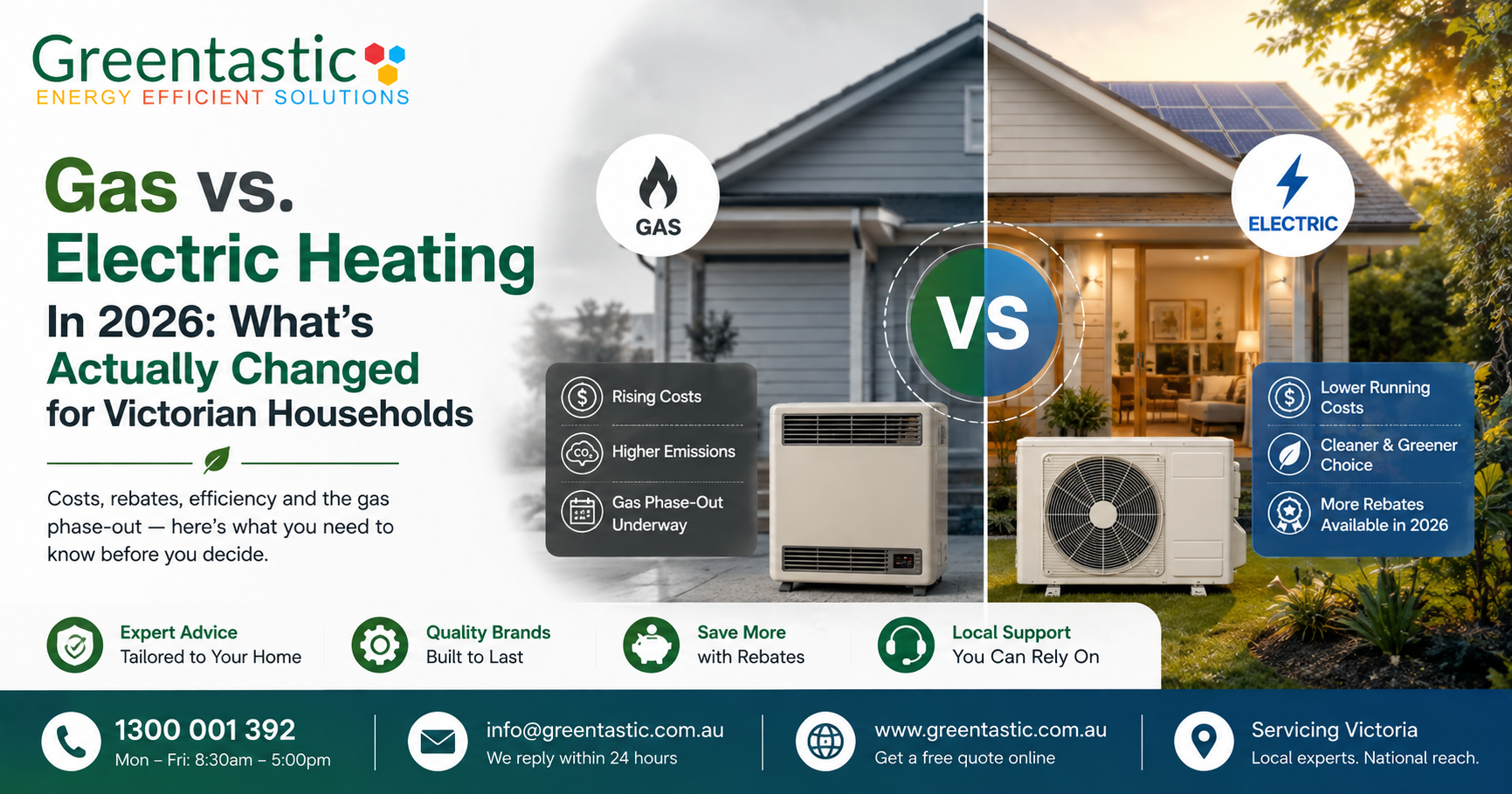
If you’ve still got a gas heater running the show at home, you’ve probably noticed the conversation around Victoria has shifted a lot lately. It’s not just marketing noise either — there have been real, government-backed changes this year that make electric heating a much easier decision than it used to be.
We get this question all the time at Greentastic: “Is it actually worth switching from gas, or is that just something companies say to sell heat pumps?” Fair question. Here’s the honest, no-fluff answer for 2026.
Why this conversation keeps coming up
Victoria has been steadily moving households away from gas for a few years now, but 2026 is when a lot of that groundwork actually starts showing up in real savings for homeowners. A few things have changed:
- The Victorian Energy Upgrades (VEU) program — the main rebate scheme behind heating and cooling upgrades — has been extended all the way through to 2045. That’s not a short-term push, that’s long-term policy.
- Ceiling insulation has recently been added as a new eligible activity under VEU, which matters because insulation and heating efficiency go hand in hand — no point upgrading your heater if half the warm air escapes through the ceiling.
- The program has also tightened up consumer protections, cracking down on pushy doorknockers and cold callers who were giving “government rebates” a bad name.
None of this means gas heating suddenly stopped working. It means the gap between what gas costs to run and what electric (specifically reverse-cycle) costs to run has kept widening, and the support to make the switch has gotten easier to access, not harder.
Gas heating in 2026: what’s actually changed
Gas itself hasn’t changed much — it still heats a room. What’s changed is the economics around it. Gas connection and usage costs have continued the trend of recent years, and single-purpose gas ducted or wall furnace systems only do one job: heating. In summer, that same system sits idle while you run a separate air conditioner.
Electric heating in 2026: what’s actually changed
This is where most of the real movement has happened:
- Reverse-cycle systems do both jobs. One system heats in winter and cools in summer, which changes the value equation completely compared to a gas-only heater.
- VEU rebates apply to eligible reverse-cycle upgrades, which can bring the upfront cost down meaningfully — though the exact discount depends on your specific system, zone, and current program settings, so it’s always worth getting a proper quote rather than assuming a number.
- Heat pump hot water systems (a separate but related upgrade) are also VEU-eligible, and pairing hot water and space heating upgrades is one of the more common “why not do both at once” conversations we have with customers.
- Insulation now sits under the same VEU umbrella, so a heating upgrade and a ceiling insulation top-up can realistically be planned together rather than as two separate projects down the track.
So which one actually makes sense for your home?
Honestly — it depends on a few things: your current system’s age, whether you’re already paying for both gas and electricity connections, how well insulated your home is, and whether you’re planning to add solar down the track (electric heating pairs naturally with solar, gas doesn’t).
If your gas heater is getting old and due for replacement anyway, 2026 is a genuinely good time to compare reverse-cycle instead of like-for-like gas replacement — not because of hype, but because the settings (extended program, insulation add-on, tighter consumer protections) are all pointing the same direction.
A quick word on checking things properly
Before committing to any upgrade, it’s worth confirming your installer is accredited under the VEU program — you can check this yourself on the official public registry: https://veu.esc.vic.gov.au/vpr/s/public-registry
That way you know the rebate you’re expecting is actually valid for your job.
The bottom line
Gas heating isn’t “banned” or obsolete overnight, but the ground has shifted enough in 2026 that most Victorian households replacing an ageing gas heater are better off seriously comparing reverse-cycle electric first. Between the extended VEU program, the new insulation option, and stronger consumer protections, it’s a more straightforward decision than it was even a year or two ago.
Greentastic is a VEU-accredited provider helping Victorian households compare gas and electric heating options honestly — no pressure, no pushy sales calls, just a straight answer for your home.
Get in touch: 📧 info@greentastic.com.au 📞 1300 001 392
Related Blogs
- The Complete Home Energy Upgrade Guide for Melbourne in 2026: Save More with Heat Pumps, Solar, Batteries & Energy-Efficient Air Conditioning
- The Complete 2026 Resource Guide to Solar, Battery and Energy Rebates for Victorian Homeowners
- The 2026 Electrified Home – Save Big by Bundling Solar & HVAC
- Electrify Your Home with Greentastic
Source note: This article references information published by the Essential Services Commission (esc.vic.gov.au) and energy.vic.gov.au regarding the Victorian Energy Upgrades program. Program settings, eligible activities, and rebate amounts are reviewed periodically and vary by system and household — always confirm current details and your specific eligibility with an accredited provider before proceeding with an upgrade.

Leave A Comment