
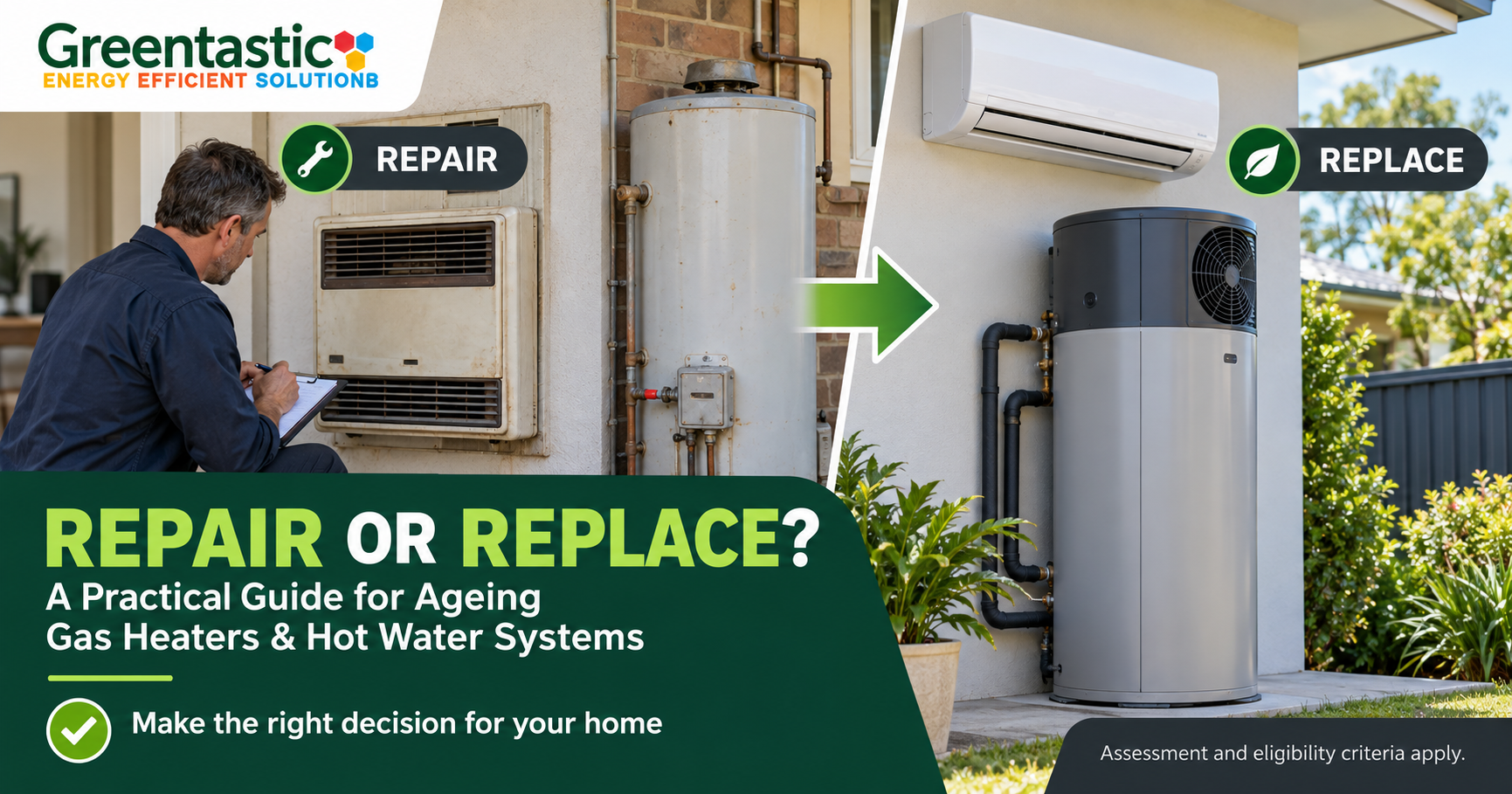
If your gas heater or hot water system is getting old and you’re weighing up another repair versus finally replacing it, you’re not alone — it’s one of the most common calls we get at Greentastic. The honest answer is: it depends on the age of your system, what the repair will actually cost, and how much rebate support you’d be leaving on the table by patching it up instead of upgrading. Here’s how to work through it properly, rather than guessing.
Step 1: How old is the system, really?
Age is the first filter, because it tells you how much runway you’ve got left before the next breakdown regardless of what you fix today.
- Under 8 years old: A repair is usually still the sensible call, provided the fault is a common, low-cost fix (a thermocouple, an igniter, a faulty valve).
- 8–12 years old: This is the grey zone. A repair might buy you another year or two, but you’re increasingly repairing a system that’s already past its efficient best — and every year you wait is a year of paying more to run it than a modern electric alternative would cost.
- Over 12 years old: At this point, most repairs are a short-term patch on a system that’s going to fail again soon regardless. This is where the maths almost always favours replacement.
Step 2: What does the repair actually cost — and what does it buy you?
A repair quote in isolation looks cheaper than a replacement quote. But the real comparison isn’t repair cost vs. replacement cost — it’s repair cost per additional year of life vs. replacement cost after rebates, spread over a system that will last 10-15+ years and cost noticeably less to run.
A $400–$600 repair that buys you 12–18 months on an ageing, inefficient system is rarely better value than putting that money toward a replacement that’s rebated, more efficient, and not going to need another emergency callout next winter.
Step 3: Factor in the rebate value you’d be walking away from
This is the step most homeowners skip — and it’s the one that changes the calculation the most.
For gas heating replacement: Under the Victorian Energy Upgrades (VEU) program, eligible households can currently receive a significant upfront discount when replacing a gas heater with a high-efficiency reverse-cycle system — the exact amount depends on whether you’re replacing a ducted or non-ducted system, and the current VEEC (Victorian Energy Efficiency Certificate) market price, which moves over time. There’s no income test on this discount, and it’s applied upfront rather than paid back later. See the Victorian Government’s official VEU page for current rates: https://www.energy.vic.gov.au/victorian-energy-upgrades
For hot water systems: The Solar Victoria hot water rebate offers up to $1,000 off an eligible heat pump or solar hot water system, rising to up to $1,400 if you choose a locally-manufactured eligible model. This is available to owner-occupiers replacing a system that’s at least 3 years old, subject to a household income cap (this dropped from $210,000 to $150,000 per year from 1 July 2026, so it’s worth checking you’re still eligible if you looked into this before that date). Full eligibility details: https://www.solar.vic.gov.au/hot-water-rebate
Both of these can potentially be combined with federal STCs (Small-scale Technology Certificates) for further savings, subject to eligibility. If you repair instead of replace, you’re not just paying for the repair — you’re also giving up access to this discount for as long as the old system keeps limping along.
Step 4: The 2027 mandate changes the calculation
This is the part of the decision that’s genuinely time-sensitive, not just a sales angle: from 1 March 2027, gas hot water systems in existing Victorian homes that reach end-of-life must be replaced with an efficient electric alternative — they can no longer simply be repaired or replaced like-for-like with another gas unit. A similar shift applies to end-of-life gas heating more broadly, as part of Victoria’s broader gas substitution direction.
What this means practically: if your system fails after March 2027, you won’t have the option of a straightforward like-for-like gas repair or replacement — you’ll be required to go electric, on whatever timeline the failure forces on you. Acting before then means:
- You choose the timing, rather than being forced into an emergency decision
- You choose the product and brand, rather than taking whatever’s available in a rush
- You avoid the installer demand surge that’s expected as the 2027 deadline approaches
- You still capture current rebate support while it’s available at today’s settings
A simple way to decide
Ask yourself these three questions:
- Is the system under 8 years old, and is the fault a simple, low-cost fix? → Repair is probably fine.
- Is the system 8+ years old, and would the repair cost more than roughly 20-30% of a rebated replacement? → Replacement is very likely the better value, especially once you factor in reduced running costs.
- Are you comfortable being forced into an emergency, unrebated, rushed decision after March 2027 if you wait for the next failure? → If not, it’s worth planning the switch on your own timeline now.
Before you get a quote
Whichever way you’re leaning, confirm these three things with any installer:
- They’re VEU-accredited — ask for the accreditation number directly.
- The specific product model is on the current approved products list for whichever rebate you’re relying on.
- The rebate is deducted from your price upfront, not promised as something to chase up afterwards.
Get a straight answer, not a sales pitch
If you’re not sure which side of this decision your system falls on, we’re happy to have an honest look and tell you plainly whether repair or replacement makes more sense for your situation — not just push a replacement because it’s the bigger job.
Greentastic Pty Ltd 📞 1300 001 392 ✉️ info@greentastic.com.au 🌐 greentastic.com.au
Rebate figures in this article are current as of publication and are indicative only — VEU discount values move with the VEEC market price, and Solar Victoria rebate eligibility and amounts are set by the Victorian Government and subject to change. Always confirm current figures and your specific eligibility via energy.vic.gov.au and solar.vic.gov.au, or ask us to check for you.
Sources:
- Victorian Energy Upgrades program — https://www.energy.vic.gov.au/victorian-energy-upgrades
- Solar Victoria hot water rebate — https://www.solar.vic.gov.au/hot-water-rebate
Related reading from Greentastic
- Gas Wall Heater Replacement Under the VEU Program — https://greentastic.com.au/gas-wall-heater-replacement-under-the-veu-program-melbourne/
- Replace Your Gas Ducted Heater Under VEU Rebates — https://greentastic.com.au/replace-your-gas-ducted-heater-under-veu-rebates-upgrade-to-energy-efficiency/
- Can I Replace My Gas Heating with an Air Conditioner? — https://greentastic.com.au/can-i-replace-my-gas-heating-with-an-air-conditioner-the-best-energy-efficient-alternatives/
- Hot Water Heat Pump Upgrades in Victoria: Costs After Rebates — Why “Free” Isn’t Reality — https://greentastic.com.au/hot-water-heat-pump-upgrades-in-victoria-what-you-need-to-know-costs-after-rebates-why-free-isnt-reality/
- Who Is Eligible for a Hot Water System Upgrade in Victoria? — https://greentastic.com.au/who-is-eligible-for-a-hot-water-system-upgrade-in-victoria/
- Can I Upgrade My Old Split System Without Changing Everything? The Truth About Hybrid Upgrades — https://greentastic.com.au/can-i-upgrade-my-old-split-system-without-changing-everything-the-truth-about-hybrid-upgrades/
- The Top 5 Mistakes Homeowners Make When Applying for VEU Rebates — https://greentastic.com.au/the-top-5-mistakes-homeowners-make-when-applying-for-veu-rebates-and-how-to-avoid-them/
- Does My Rental Property Qualify for a VEU Rebate? Landlord vs Tenant Explained — https://greentastic.com.au/does-my-rental-property-qualify-for-a-veu-rebate-landlord-vs-tenant-explained/
- The Future of Heating & Cooling in Victoria: Where Rebates Are Heading in 2026 — https://greentastic.com.au/the-future-of-heating-cooling-in-victoria-where-rebates-are-heading-in-2026/

Leave A Comment