
Expert guidance for Victorian homeowners planning smarter, fully-electrified homes
Rooftop solar has become a common sight across Victoria — but many homeowners are now discovering that solar alone doesn’t always deliver the savings they expected.
At Greentastic, we regularly assess homes where solar systems are exporting large amounts of energy to the grid, yet households are still paying high electricity bills. The reason lies in how solar exports work today, how the grid is changing, and why storage and electrification planning matter more than ever.
This guide explains where your excess solar power really goes — and how the right assessment can unlock far greater value from your system.
How Solar Export Works (And Why It’s No Longer Enough)
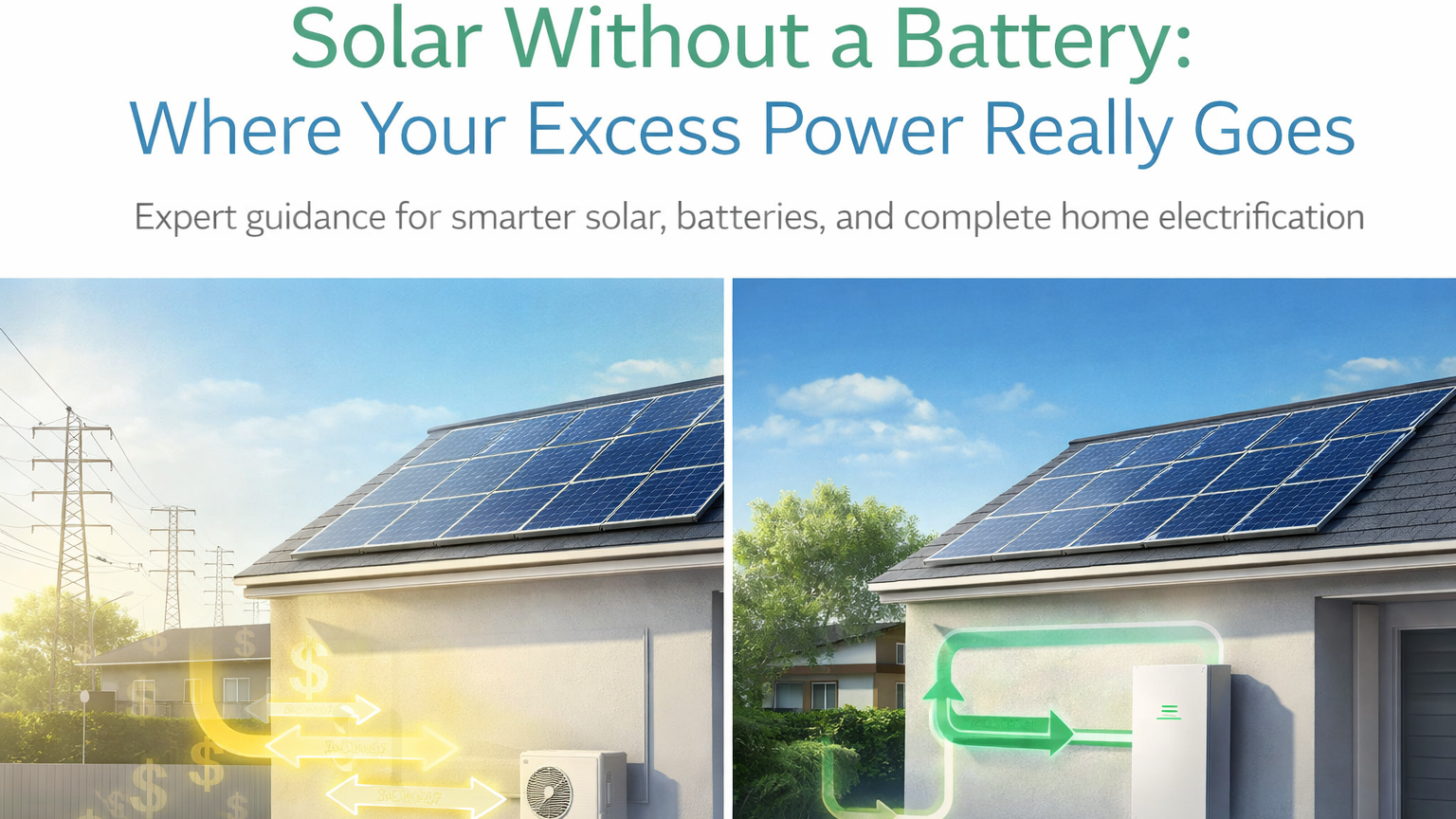
When your solar system produces more electricity than your home is using, the excess energy is automatically exported to the electricity grid. In return, your retailer applies a feed-in tariff (FiT) as a credit on your bill.
While this system once made financial sense, today the situation is very different:
- Electricity you export is often credited at a fraction of what you pay to buy power back
- Export pricing changes by retailer and time of day
- There is no guaranteed minimum feed-in tariff in Victoria
From an energy-design perspective, exporting solar is now the least valuable use of the energy your system produces.
Why Daytime Oversupply Has Reduced Solar Export Value
Victoria has one of the highest rates of rooftop solar uptake in Australia. While this is positive for clean energy, it has created a new challenge: midday oversupply.
Between late morning and early afternoon:
- Thousands of homes export solar at the same time
- Wholesale electricity prices drop sharply
- Feed-in tariffs are reduced accordingly
In some cases, exported solar during peak daylight hours is valued close to zero, even though that same energy would cost significantly more to buy back in the evening.
This is why Greentastic focuses on self-consumption and storage-led system design, rather than export-dependent savings.
Export Limits & Grid Congestion in Victoria and NSW
Beyond pricing, the physical electricity network also has limits.
As solar penetration increases, distribution networks may impose export caps to protect grid stability. This can result in:
- Temporary or permanent limits on how much solar your system can export
- Export reductions during periods of network congestion
- Excess solar generation going unused if it can’t flow to the grid
Without a battery or flexible load (such as heat pumps or EV charging), this energy is effectively wasted potential.
A professional assessment helps identify whether export constraints already apply — or are likely to apply — to your property.
What Happens During Grid Congestion?
During times of high solar generation and low demand:
- Networks prioritise grid stability
- Export limits may be enforced dynamically
- Solar systems continue generating, but energy may not leave the home
From a homeowner’s perspective, this can mean:
- Lost export credits
- Lower overall system value
- Missed opportunities to use that energy internally
This is one of the strongest technical reasons why batteries and electrified appliances are becoming essential components of modern home energy systems.
Why Batteries Change the Equation
A home battery allows you to:
- Store excess solar instead of exporting it
- Use your own energy during evening peak times
- Reduce reliance on high-priced grid electricity
- Increase solar self-consumption dramatically
At Greentastic, we design battery systems not as standalone products, but as part of a broader electrification strategy — ensuring compatibility with solar, future EV chargers, heat pumps, and Virtual Power Plant participation.
Virtual Power Plants (VPPs): An Emerging Opportunity
Victoria has supported several Virtual Power Plant (VPP) programs, enabling homes with batteries to:
- Support the grid during peak demand
- Receive additional incentives or credits
- Play an active role in grid stabilisation
While VPP participation isn’t suitable for every household, VPP-ready systems provide future flexibility and potential financial upside.
Greentastic assessments include:
- Battery and inverter compatibility checks
- VPP readiness evaluation
- Clear explanation of benefits vs trade-offs
Rebates, Incentives & Long-Term Planning
Rebate programs change regularly, and many homeowners are unsure what still applies.
Our role isn’t just installation — it’s guidance:
- Explaining current Victorian and federal incentives
- Designing systems that remain compliant as programs evolve
- Avoiding short-term decisions that limit future upgrades
Whether rebates are available now or not, proper system design ensures your investment continues delivering value for years to come.
Why Professional Assessment Matters
Every home is different:
- Roof orientation
- Daytime vs evening energy use
- Heating, cooling, and hot water loads
- Future EV or battery plans
Greentastic specialises in whole-of-home electrification assessments, ensuring solar, batteries, heat pumps, and EV infrastructure work together — not in isolation.
We don’t just install systems.
We engineer solutions around how you actually live.
The Greentastic Difference
✔ Expert assessment before installation
✔ Battery-ready, VPP-aware system design
✔ Solar, batteries, heat pumps & EV charging
✔ End-to-end electrification under one provider
✔ Clear, honest guidance — no guesswork
Solar without a battery still reduces daytime grid usage — but in today’s energy environment, exporting excess power often delivers minimal value.
With the right guidance, your solar system can become the foundation of a fully electrified, future-ready home — one that keeps energy where it belongs: with you.
If you’re considering upgrades, Greentastic can assess your home, explain your options clearly, and deliver a complete electrification solution built for long-term savings.
Leave A Comment