
By Greentastic Pty Ltd | Updated 2026 | 12 min read | Melbourne & Victoria
Meta Description: Not sure which home energy upgrade to do first in Melbourne? This complete 2026 guide covers air conditioning, hot water heat pumps, solar panels and batteries — with real rebate figures, payback periods, and the exact order to maximise your return on investment.
Why the Order of Your Upgrades Matters More Than You Think
Every Melbourne homeowner knows energy upgrades are a smart move. Rising power bills, an ageing gas network, the Victorian Government’s 2027 electrification deadlines, and some of the most generous rebates ever offered in Australia all point in the same direction: electrify your home now and save for decades.
But here is the thing most people get wrong: they start with solar.
Solar panels are the most visible and well-marketed energy upgrade. They feel like the logical first step. But for the majority of Melbourne homes still running gas heating and gas hot water, installing solar before eliminating gas is like filling a leaking bucket. You are generating free electricity but still burning expensive gas for your two biggest energy loads.
The order you do things in determines how quickly each upgrade pays for itself, how large a solar system you actually need, and how much money you leave on the table in unclaimed rebates.
This guide gives you the definitive, numbers-backed upgrade sequence for Melbourne homes in 2026 — covering air conditioning and heating, hot water, solar panels, and battery storage — with every rebate, payback figure, and link to further reading you need to make confident decisions.
Understanding the Victorian Energy Landscape in 2026
Before diving into the upgrade sequence, here are the facts that frame every decision.
Gas prices have risen 40 to 50 percent in real terms since 2019. Victoria’s Bass Strait gas fields are in structural decline. The state is increasingly reliant on Queensland gas and imported LNG, both priced at international market rates. Energy analysts expect this upward trajectory to continue through to 2030 and beyond.
The 2027 gas phase-out is now less than 12 months away. From 1 January 2027, no new homes built in Victoria may connect to the gas network. From 1 March 2027, gas hot water systems and gas heating systems must be replaced with electric alternatives when they reach end-of-life. This does not force you to remove a working gas appliance immediately — but it does mean the next time it breaks down, you must replace it with an electric system.
The VEU program is open to all Victorian households with no income test. The Victorian Energy Upgrades program applies rebates directly to your invoice through accredited providers like Greentastic. You do not lodge a separate application or wait for a bank transfer. The discount comes off what you pay on the day.
Federal rebates for batteries launched 1 July 2025. The Cheaper Home Batteries Program provides approximately 30 percent off eligible battery storage systems with no income test and no property value cap.
Solar Victoria rebates require a household income under $210,000 and property value under $3 million. These apply to solar panels, solar batteries (until the program wound down), and hot water heat pumps under the Solar Homes program.
With that context established, here is exactly how to sequence your upgrades.
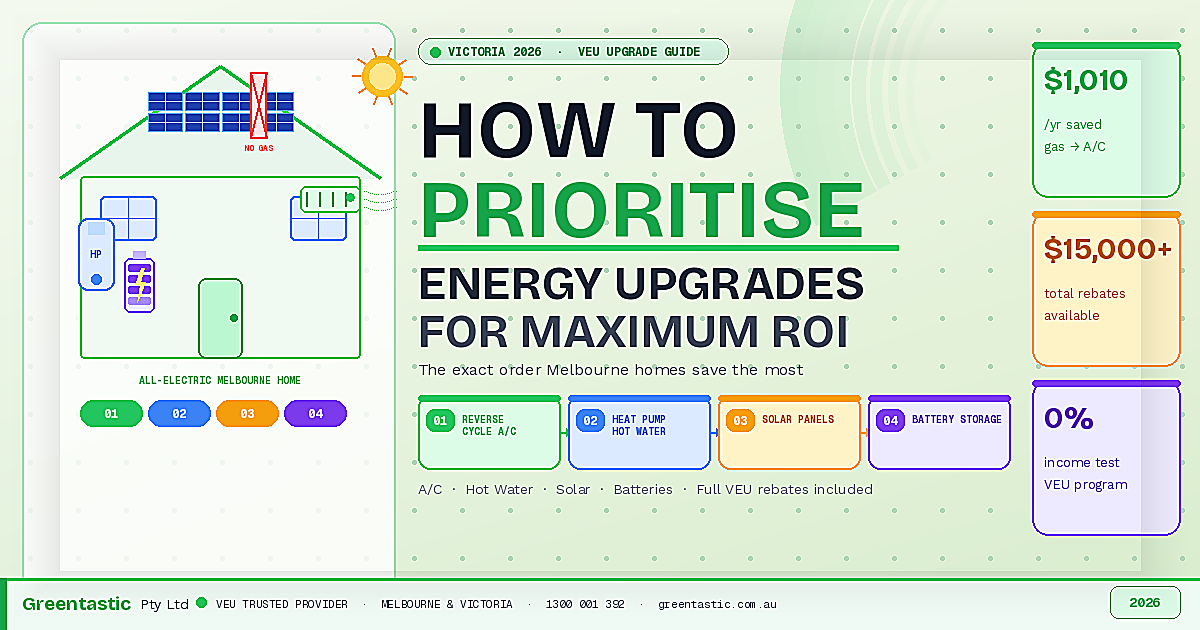
The 2026 Melbourne Home Energy Upgrade Priority Order
Priority 1: Replace Gas Heating with Reverse Cycle Air Conditioning
Priority 2: Replace Gas Hot Water with a Heat Pump
Priority 3: Install Solar Panels
Priority 4: Add Battery Storage
Priority 5: EV Charging and Further Electrification
Each is covered in full below.
Priority 1 — Replace Gas Heating with Reverse Cycle Air Conditioning
Why it comes first: Space heating accounts for 40 to 60 percent of a typical Melbourne household’s total energy bill. It is the single largest energy cost in most homes and the category where gas is most disadvantaged against modern electric alternatives. Fixing this first delivers the biggest immediate bill reduction and unlocks the highest VEU rebate available.
The Efficiency Gap Is Enormous
A gas ducted heater operating at its best converts around 85 to 92 cents of every dollar of gas into usable warmth. A modern reverse cycle air conditioner with a Coefficient of Performance (COP) of 3.5 delivers $3.50 worth of heat for every $1 of electricity. That is not a marginal difference — it is a fundamental difference in technology. Reverse cycle does not generate heat; it moves existing heat from outside air into your home, which is far less energy-intensive than burning gas.
Even accounting for Victoria’s electricity tariffs, reverse cycle delivers 3 to 4 times more heat per dollar than gas. This advantage holds across Melbourne’s full range of winter temperatures. Modern inverter-driven reverse cycle systems are rated to operate efficiently down to minus 15 degrees Celsius — well beyond anything Melbourne’s winters produce.
The VEU Rebate Is at Its Most Generous for Gas Replacements
The VEU program calculates your discount based on the greenhouse gas emissions your upgrade eliminates. Replacing ducted gas heating with reverse cycle electric is one of the largest single emissions reductions achievable in a residential upgrade — which is why it attracts the highest rebate.
Replacing ducted gas heating: VEU discount of up to $5,000 or more, depending on system size and home. Annual bill saving of up to $1,010 per year based on Victorian Government modelling.
Replacing gas wall heaters: VEU discount of $800 to $2,500 per unit. Multiple units replaced in a single job stack the discount. Annual saving of approximately $370 per gas wall heater replaced.
Lifetime saving from switching one gas wall heater to a split system: over $7,000 across the system’s life.
Neither requires an income test. Both apply to all Victorian households and businesses regardless of income or property value.
Read more: Reverse cycle systems with ducted heating upgrades and VEU rebates — Greentastic
Which System Is Right for Your Melbourne Home?
Single split system: One indoor wall unit connected to one outdoor unit. Best for individual rooms or open-plan living areas. Ideal first step for homes replacing one or two gas wall heaters. Installation typically takes 3 to 5 hours.
Multi-head split system: One outdoor unit connected to multiple indoor units across different rooms, each with independent temperature control. The most popular solution for Melbourne homes replacing multiple gas wall heaters or achieving whole-home coverage without ductwork. A 4-head system covering the main living areas can usually be installed in a single day.
Ducted reverse cycle: A single system distributing conditioned air through ceiling vents throughout the home with zoned control. The direct replacement for ducted gas heating — same coverage and comfort profile, dramatically lower running costs.
Greentastic installs all system types from Daikin, Mitsubishi Electric, Fujitsu, Panasonic, Carrier, and Midea. All systems supplied are VEU-approved.
The Cooling Bonus: Two Appliances for the Price of One
Gas heaters heat only. A reverse cycle air conditioner heats in winter and cools in summer from the same unit at no additional running cost penalty. Melbourne’s climate data shows a clear and accelerating trend toward more intense summer heat events. The cooling capability of reverse cycle is no longer a convenience — it is increasingly a necessity.
When you calculate the ROI of switching from gas to reverse cycle, you are not just counting the heating bill saving. You are also replacing any separate cooling equipment you would otherwise need for summer, reducing the effective payback period further.
Read more: Conquer Melbourne’s Climate Like a Pro — Greentastic
Payback Period
After VEU discount, a multi-head split system replacing ducted gas in a typical 4-bedroom Melbourne home typically costs $3,000 to $8,000 installed. Annual savings of $700 to $1,010 produce a payback period of 2 to 5 years. The system then runs for 15 or more years — representing $10,000 to $15,000 in total savings over its life.
Priority 2 — Replace Gas Hot Water with a Heat Pump
Why it comes second: Hot water accounts for 20 to 25 percent of a typical Melbourne household’s total energy spend. It is the second-largest energy cost after space heating and the upgrade with the most stacking rebate opportunity in the entire program — three separate incentive streams can combine to dramatically reduce or eliminate upfront cost.
How Heat Pump Hot Water Works
A heat pump hot water system works on the same refrigerant cycle principle as a reverse cycle air conditioner. It extracts thermal energy from ambient air and uses it to heat water — rather than using an electric element to heat water directly (the way a traditional electric storage system works) or burning gas.
The efficiency advantage is substantial. According to the Australian Renewable Energy Agency (ARENA), heat pump hot water systems can reduce hot water energy costs by up to 80 percent compared to traditional electric resistance systems. Compared to gas hot water, households typically save $300 to $500 per year on energy bills, beginning on the day of installation.
Modern heat pump systems are designed to operate effectively in Melbourne’s cooler months. Unlike solar thermal systems, they do not depend on direct sunlight and maintain performance reliability throughout Victoria’s variable climate.
Stack Three Rebates for Maximum Upfront Savings
This is the upgrade with the most powerful stacking opportunity in the Victorian rebate landscape.
VEU discount: Applied directly by Greentastic as your trusted provider. No income test. Reduces the purchase price through Victorian Energy Efficiency Certificates created on your behalf.
Solar Victoria hot water rebate: Up to $1,400 for eligible locally manufactured systems (from 1 July 2025), or $1,000 for other eligible systems. Requires household income under $210,000 and property value under $3 million.
Federal Small-scale Technology Certificates (STCs): Worth approximately $2,500 to $3,000 for an eligible heat pump hot water system in Victoria, depending on the system size and current STC spot price. Applied by your installer.
When all three stack together, many Melbourne households install a heat pump hot water system with zero or near-zero out-of-pocket cost, while locking in $300 to $500 in annual energy savings from day one.
Australian-Made Systems Attract the Higher Rebate
From 1 July 2025, households choosing an eligible locally manufactured hot water product qualify for the $1,400 Solar Victoria rebate rather than the $1,000 rate available for imported alternatives. Greentastic can confirm which products on the current approved list are locally made at the time of your quote.
Do Not Wait for Your System to Fail
If your gas hot water system is over 8 years old, acting proactively — rather than waiting for a breakdown — is strongly recommended. A failed hot water system is an emergency that forces rushed decisions. Booking a planned replacement with Greentastic means you choose the timing, the system, and capture all three rebate streams without pressure.
Note: If your hot water system fails unexpectedly, you may still qualify for the rebates — you do not need to wait for eligibility confirmation before an emergency installation, but you must prove eligibility as soon as possible after installation.
Read more: Benefits of Replacing Your Hot Water System with a Heat Pump — Greentastic
Read more: Air Conditioner and Hot Water Heat Pump Installation — Greentastic
Payback Period
With all three rebates applied, out-of-pocket cost is often near zero. At $330 to $500 saved per year on energy bills, the system pays for any remaining out-of-pocket cost within 1 to 3 years and then generates pure savings for 15 or more years of system life.
Priority 3 — Install Solar Panels
Why it comes third: Once your two largest energy consumers — heating and hot water — are running on electricity instead of gas, solar panels become dramatically more effective. Your electricity consumption is now higher (because you have converted from gas), but it is now entirely solar-compatible. Every kilowatt of solar generation can offset your heating, cooling, and hot water costs — none of which was possible while those loads ran on gas.
Installing solar before completing Priorities 1 and 2 means you are likely undersizing your solar system for the home you are building toward. It also means the Solar Victoria rebate — available only once per property in a 10-year period — is spent before you have optimised your home’s electricity demand profile.
Solar Victoria Rebate: What You Can Claim
Rebate amount: Up to $1,400, or 50 percent of the system purchase price after other discounts, whichever is lower. Interest-free loan: Up to $1,400 on top of the rebate, bringing total upfront state support to $2,800. Federal STCs: For a 6.6 kW system, federal Small-scale Technology Certificates are worth approximately $1,600 to $2,000 depending on current STC prices. Eligibility: Owner-occupier, combined household taxable income under $210,000, property value under $3 million, property has not previously received a solar panel rebate under this program within the last 10 years.
Apartment and townhouse residents: Separate rebates of up to $2,800 per household apply for residents of eligible apartments, units, and townhouses under the strata solar program.
What Size Solar System Should Melbourne Homes Install in 2026?
The common recommendation of 6.6 kW was appropriate for homes still relying on gas for heating and hot water. A home that has completed Priorities 1 and 2 — converting to reverse cycle heating and heat pump hot water — typically needs more generation capacity.
All-electric 3-bedroom home: 8 to 10 kW recommended. All-electric 4-bedroom home: 10 to 13 kW recommended. All-electric home adding EV charging: 13 kW or more recommended.
Oversizing while the Solar Victoria rebate is available is generally the better financial decision. The rebate cap is the same for a 6.6 kW or 10 kW system — so there is no additional rebate benefit to staying small, while there is significant generation benefit to going larger.
Annual Bill Reduction
A well-sized solar system on an all-electric Melbourne home typically reduces electricity bills by $1,200 to $2,000 per year, depending on system size, orientation, consumption patterns, and tariff structure. Feed-in tariff revenue from excess generation during the day adds further benefit, though Victorian feed-in rates have moderated in recent years.
Payback Period
A 10 kW solar system after rebates typically costs $6,000 to $10,000 installed. Annual bill reduction of $1,200 to $2,000 produces a payback period of 4 to 6 years. The system then continues generating for 15 to 25 years — representing $18,000 to $50,000 in total lifetime value.
Read more: VEU Rebates for Solar and Battery Systems: What You Should Know — Greentastic
Priority 4 — Add Solar Battery Storage
Why it comes fourth: A battery makes the most financial sense once solar is generating excess power that would otherwise be exported to the grid at low feed-in rates. Without solar generating excess daytime power, a battery’s savings potential is significantly reduced.
The 2025 and 2026 window is the most favourable battery purchasing environment Australian homeowners have ever seen, thanks to the federal Cheaper Home Batteries Program.
Federal Cheaper Home Batteries Program (from 1 July 2025)
Discount: Approximately 30 percent off the upfront cost of eligible battery systems. Maximum rebate per kWh: $372 per kilowatt-hour for systems up to 50 kWh (2025 rate). Maximum total saving on a single system: Up to $18,600 on a full eligible installation. Income test: None. Property value cap: None. System size requirement: Between 5 kWh and 100 kWh. Products must be: Listed on the Clean Energy Council approved product list.
The rebate reduces year-on-year through to 2030. Acting in 2026 means accessing a higher rebate than will be available in 2027, 2028, and beyond.
Popular Eligible Battery Systems for Melbourne Homes
Tesla Powerwall 3: 13.5 kWh. One of Australia’s most popular residential batteries. Includes integrated inverter. Well-suited to Melbourne’s moderate export/import profile.
BYD Battery-Box Premium: Modular from 5 to 60+ kWh. Allows staged expansion. Compatible with most leading inverter brands.
AlphaESS Smile series: 5 to 26 kWh. Strong value proposition for Melbourne households. Greentastic is an authorised AlphaESS installer.
GoodWe Lynx Home series: 5 to 30+ kWh. Compatible with GoodWe inverters. Well-suited to homes with existing GoodWe solar.
Sungrow SBR: 9.6 to 25.6 kWh modular. Increasingly popular in Victoria due to competitive pricing and CEC approval.
Read more: The Ultimate Guide to Solar Batteries in Melbourne Victoria — Greentastic
Read more: Alpha ESS vs GoodWe Solar Batteries: A Complete Comparison — Greentastic
Energy Self-Sufficiency After a Full Upgrade
A Melbourne home that has completed all four priorities — reverse cycle heating and cooling, heat pump hot water, 10 kW solar, and a 13.5 kWh battery — can expect annual electricity bills of under $500, down from a combined gas and electricity bill that typically runs $3,500 to $5,500 for an equivalent gas-reliant home. In strong solar seasons, many such homes achieve net annual energy credit.
Payback Period
After the federal rebate, a 13.5 kWh battery system typically costs $8,000 to $12,000 fully installed. Annual savings of $800 to $1,500 (from avoiding grid imports in the evening and overnight) produce a payback period of 6 to 10 years. As grid electricity prices continue rising, this payback period will shorten over time.
The Complete Melbourne Upgrade: Rebate Stacking Summary
Here is every rebate available in 2026 for a full home electrification project, shown together:
Gas ducted heating → Reverse cycle ducted or multi-head VEU discount: up to $5,000 or more. Income test: none.
Gas wall heaters → Split systems VEU discount: $800 to $2,500 per unit. Income test: none.
Gas hot water → Heat pump VEU discount: applicable. Solar Victoria rebate: up to $1,400. Federal STCs: approximately $2,500 to $3,000. Income test: Solar Victoria only (under $210,000).
Solar panels (10 kW) Solar Victoria rebate: up to $1,400 plus $1,400 interest-free loan. Federal STCs: approximately $2,500 to $3,200. Income test: Solar Victoria only (under $210,000).
Solar battery (13.5 kWh) Federal Cheaper Home Batteries Program: approximately 30 percent discount, up to approximately $5,000 on a 13.5 kWh system. Income test: none.
Total potential support across a full project: well over $15,000 in combined Victorian and federal rebates, discounts, and certificates for a typical Melbourne 4-bedroom home completing all four upgrade stages.
What If You Have a Limited Budget — Which Upgrade Do You Do First?
If you cannot do everything at once, this is the financially optimal single first move depending on your home’s current setup:
I have ducted gas heating: Replace it with a multi-head split system or reverse cycle ducted system. This delivers the highest VEU discount and the largest annual bill saving of any single upgrade available to your home. Do this before anything else.
I have gas wall heaters only (no ducted): Replace the heater in your main living area with a split system. Even one replacement attracts a meaningful VEU discount and eliminates gas from your biggest-used room. Then expand room by room.
I have no gas at all (already electric): Install solar panels. Your home’s electricity consumption is your biggest cost and 100 percent solar-compatible. The Solar Victoria rebate plus STCs make this the highest-value first move for an already-electric home.
My hot water system is over 10 years old: Prioritise a heat pump hot water upgrade before it fails unexpectedly. The three-rebate stacking opportunity makes this extremely low-cost or free — and it starts saving you money on day one.
Common Questions Melbourne Homeowners Ask
Do I lose the Solar Victoria rebate if I upgrade solar before gas? No — the Solar Victoria rebate is available regardless of whether you still have gas appliances. However, you may need to upsize your solar system later if you add reverse cycle and heat pump loads after installation, and you can only claim the Solar Victoria solar rebate once per property in a 10-year period. Timing matters.
Can I get all the rebates in the same year? Yes. VEU discounts, Solar Victoria rebates, STCs, and the federal battery rebate are all separate programs and can all be claimed in the same calendar year. Greentastic manages all rebate paperwork across every program simultaneously for whole-home projects.
Does bundling upgrades save money on installation? Generally yes. Having solar, a heat pump hot water system, and reverse cycle air conditioning installed in a coordinated project typically reduces overall installation cost compared to booking them separately across multiple years. Greentastic offers whole-home energy upgrade packages for this reason.
What happens if my gas appliance breaks down after March 2027? You will be required to replace it with an eligible electric alternative. The VEU rebate should still be available, but installer availability may be constrained as demand peaks around the 2027 deadline. This is one of the strongest arguments for acting before that pressure builds.
Is the VEU rebate available for rental properties? Some VEU upgrades apply to rental properties — particularly hot water upgrades. The Solar Victoria rental solar program also provides rebates for landlords installing solar on eligible rental properties. Contact Greentastic to discuss your specific situation.
Will electricity prices keep rising? Independent forecasts from AEMO and energy market analysts consistently project continued electricity price increases through the late 2020s in Victoria, driven by grid transition costs and rising gas prices flowing through to gas-fired peaking generation. However, the efficiency multiplier of reverse cycle and the zero-marginal-cost generation of solar provide a structural hedge against rising tariffs. The more of your energy you generate yourself and the more efficiently you use it, the less exposed you are to grid price movements.
Why Melbourne Homeowners Choose Greentastic
Greentastic is one of Melbourne and Victoria’s most trusted providers of energy-efficient home upgrades, with hundreds of successful installations across metropolitan Melbourne and surrounding suburbs.
What makes Greentastic different:
We handle the entire project end-to-end. From your initial free home assessment through system selection, installation, and government rebate lodgement across VEU, Solar Victoria, and federal STC programs — you deal with one team who manages everything.
We are product-agnostic within quality brands. Rather than pushing one manufacturer’s product, we recommend the system that best suits your home’s layout, usage patterns, and budget from our range of approved suppliers including Daikin, Mitsubishi Electric, Fujitsu, Panasonic, AlphaESS, GoodWe, and more.
We do not charge separately for rebate management. The VEU discount, Solar Victoria application support, and STC lodgement are included in our service. You see the full rebate benefit in your invoice price.
Further Reading: Related Greentastic Blogs
Going deeper on any of these topics? Here are the most relevant articles already published on the Greentastic website:
Air Conditioning and Heating: Conquer Melbourne’s Climate Like a Pro: Greentastic Unveils Your Energy-Efficient AC Solutions https://greentastic.com.au/melbourne-ac-experts-conquer-climate-with-energy-saving-solutions/
Reverse Cycle Systems with Ducted Heating Upgrades and VEU Rebates: The Smart Move for Your Home https://greentastic.com.au/reverse-cycle-systems-with-ducted-heating-upgrades-and-veu-rebates/
Maximising Comfort and Efficiency: Upgrading Gas Heating to Ducted or Reverse Cycle Air Conditioners Under the VEU Program https://greentastic.com.au/maximizing-comfort-and-efficiency-upgrading-gas-heating-to-ducted-or-reverse-cycle-air-conditioners-under-the-veu-program/
VEU Rebates Explained: What Types of Air Conditioners Qualify in 2026 https://greentastic.com.au/blog/
Why Reverse Cycle Heating Aligns with Victoria’s 2027 Electrification Strategy https://greentastic.com.au/blog/
Hot Water Heat Pumps: Benefits of Replacing Your Hot Water System with a Heat Pump (Melbourne and Metro Areas) https://greentastic.com.au/benefits-of-replacing-your-hot-water-system-with-a-heat-pump-melbourne-metro-areas/
Air Conditioner and Hot Water Heat Pump Installation in Melbourne Victoria https://greentastic.com.au/enhance-your-home-comfort-air-conditioner-and-hot-water-heat-pump-installation/
Solar Panels and Batteries: The Ultimate Guide to Solar Batteries in Melbourne Victoria (2025) https://greentastic.com.au/blog/
Alpha ESS vs GoodWe Solar Batteries: A Complete Comparison for Melbourne Victoria Homes https://greentastic.com.au/blog/
VEU Rebates for Solar and Battery Systems: What You Should Know https://greentastic.com.au/blog/
Your Complete 2026 Home Energy Upgrade Guide: Solar, Batteries, Air Conditioning and Heat Pumps with Victorian Government Rebates https://greentastic.com.au/blog/
Victoria’s 2025 Energy Rebates Update: How Greentastic Helps You Save More with Solar, Batteries, and Efficient Home Upgrades https://greentastic.com.au/blog/
VEU Program: Upgrading Floor Heating Under the VEU Program: A Smart Move for Comfort and Savings https://greentastic.com.au/upgrading-floor-heating-under-the-veu-program-a-smart-move-for-comfort-and-savings/
How to Choose the Right VEU-Approved Heating and Cooling System for Your Home https://greentastic.com.au/blog/
STC vs VEU vs Solar Victoria: Understanding the Three Rebate Programs https://greentastic.com.au/blog/
Book Your Free Home Energy Assessment Today
Greentastic offers a free, no-obligation home energy assessment for Melbourne and Victoria homeowners. During your assessment, a Greentastic specialist will:
Walk through your current gas appliances and identify every VEU rebate you qualify for. Calculate your personalised annual savings from each upgrade. Recommend the optimal upgrade sequence for your home and budget. Provide itemised quotes with all rebates and discounts already applied. Handle all paperwork and lodgement across VEU, Solar Victoria, STCs, and the federal battery program.
There is no pressure, no obligation, and no cost for the assessment.
Call us: 1300 001 392 Phone (direct): 0485 952 870 Email: info@greentastic.com.au Website: www.greentastic.com.au Blog: www.greentastic.com.au/blog/
Greentastic Pty Ltd — Melbourne and Victoria’s trusted home energy upgrade specialists. Helping Victorian homeowners slash bills, claim every rebate, and build all-electric homes that perform for decades.
© 2026 Greentastic Pty Ltd. All rights reserved. Rebate figures are indicative and based on current Victorian Government and federal program rules as of 2026. Individual savings and rebate amounts will vary based on your home, system size, usage patterns, and current certificate values. Always confirm current rebate values with a trusted provider before committing to an upgrade. Greentastic is a VEU trusted provider operating across Melbourne and Victoria.

Leave A Comment