
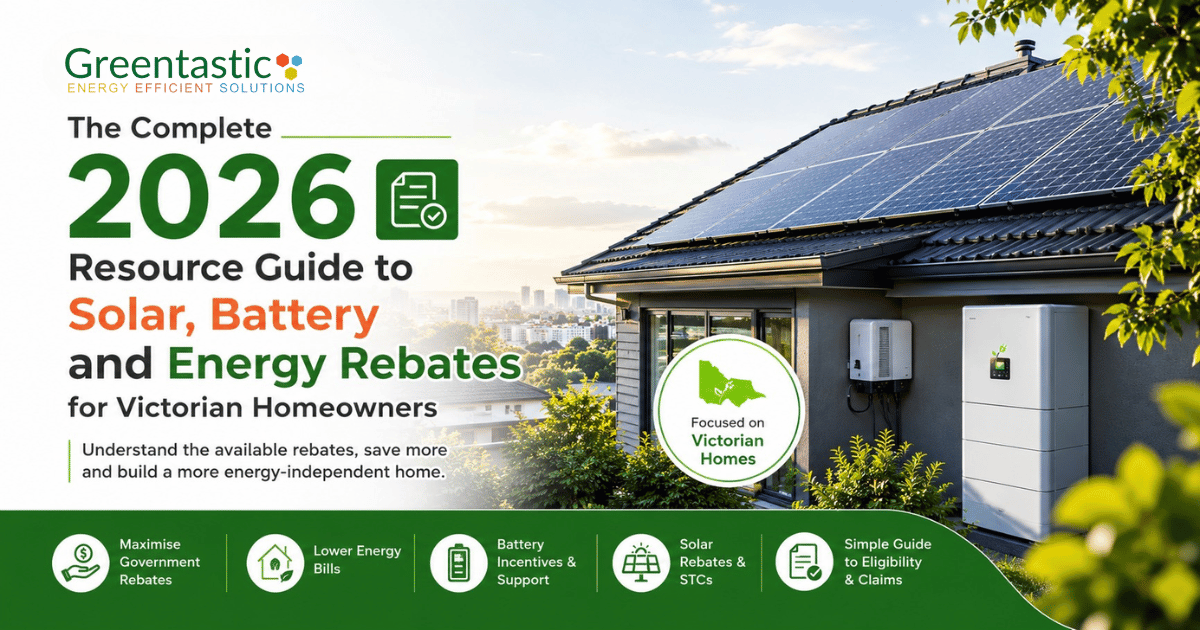
If you’ve been trying to make sense of Victoria’s energy rebate landscape this year, you’re not alone. Between VEU, STCs, Solar Victoria, and the various changes rolling in through 2026, it’s genuinely a lot to keep straight — even for people who follow this stuff closely.
We’ve put together this guide as a starting point. Rather than trying to cram everything into one article, we’ve pulled together the resources our team has built covering each part of the process, so you can jump straight to whatever’s relevant to your situation.
Start here: figure out what to upgrade first
Not every upgrade delivers the same return, and doing things in the wrong order is one of the most common (and expensive) mistakes we see. If you’re standing at the start of this process wondering whether to tackle solar, heating, or hot water first, our guide on how to prioritise home energy upgrades in Melbourne for maximum ROI (https://greentastic.com.au/how-to-prioritise-home-energy-upgrades-in-melbourne-for-maximum-roi/) walks through the decision in the order that actually makes financial sense. We’ve also put together a more detailed 2026 version of that same framework (https://greentastic.com.au/how-to-prioritise-home-energy-upgrades-in-melbourne-for-maximum-roi-2026-guide/) that accounts for this year’s rebate changes specifically, which is worth a look if you’re planning your upgrades over the next 12 months rather than doing everything at once.
Before any of that, though, it helps to actually understand where your money is going in the first place. Our breakdown of where your electricity bill actually goes (https://greentastic.com.au/where-your-electricity-bill-goes-reduce-home-energy-costs/) is a good five-minute read if you’ve never sat down and worked out which appliances are actually driving your costs.
The VEU program: what it covers and how much it’s worth
The Victorian Energy Upgrades program is behind most of the upfront discounts you’ll see mentioned when you get a quote, but it covers more ground than most people realise. If you’re specifically looking at replacing an old ducted gas heater, our guide to the VEU rebate for ducted gas heater replacement in Melbourne (https://greentastic.com.au/veu-rebate-ducted-gas-heater-replacement-melbourne-2026/) breaks down exactly what’s on offer this year — this is typically the single largest VEU discount available to Victorian households, so it’s worth reading even if you’re not ready to book anything yet.
If you’re torn between a multi-split system and a full ducted reverse cycle replacement, we’ve written specifically about which option delivers the biggest VEU rebate when replacing gas heating (https://greentastic.com.au/multi-split-vs-ducted-reverse-cycle-victoria-biggest-veu-rebate-when-replacing-gas-heating/) — the answer isn’t always obvious, and it depends more on your home’s layout than most people expect.
Hot water is the other big one. Heat pump hot water systems are quietly one of the better value upgrades going, and our 2026 hot water system upgrade guide for Melbourne (https://greentastic.com.au/hot-water-system-upgrade-melbourne-2026/) covers current eligibility and what kind of discount you can expect.
And because eligibility rules do shift year to year, we keep a dedicated page on VEU rebate eligibility for 2026 in Victoria (https://greentastic.com.au/veu-rebate-eligibility-2026-in-victoria/) up to date — that’s the one to check first if you’re not sure whether your home or your existing system even qualifies.
VEU, STCs, or both? Clearing up the confusion
This is genuinely the most common question we get, and it makes sense why — VEU and STCs are two completely different schemes (one state, one federal) that often apply to the same installation, and the rules around stacking them aren’t exactly intuitive. We’ve laid it all out plainly in VEU vs STCs: what’s the difference and can I claim both in Victoria (https://greentastic.com.au/veu-vs-stcs-difference-can-i-claim-both-victoria/), including which upgrades let you combine both discounts and which ones don’t.
Going solar: where to actually start
If solar panels or battery storage are on your radar, the sensible first move is a proper site assessment rather than guessing at system size based on what a neighbour installed. Our free solar assessment for Melbourne and Victoria (https://greentastic.com.au/free-solar-assessment-melbourne-victoria/) covers exactly what that involves and what you’ll walk away with.
Worth flagging too: Solar Victoria’s income eligibility cap for the solar panel and hot water rebates tightened partway through 2026, dropping from $210,000 to $150,000 per household. If you’ve been putting off applying, it’s worth checking where you sit against the current threshold rather than assuming last year’s rules still apply.
Solar and battery storage, suburb by suburb
Because system sizing, roof orientation, and even rebate eligibility can vary depending on where you actually live, we’ve built out dedicated resources for a number of the areas we install in most often across greater Melbourne.
Melton — we’ve covered this area from two angles: a general look at solar panel and battery options in Melton (https://greentastic.com.au/solar-panels-battery-melton-vic/), and a second, more detailed breakdown of packages and pricing (https://greentastic.com.au/solar-panels-battery-melton-vic-2/) for households further along in the decision process.
Doncaster — similarly, there’s an overview of solar panels and battery systems for Doncaster homes (https://greentastic.com.au/solar-panels-battery-doncaster-vic/), plus a page focused specifically on battery storage options in Doncaster (https://greentastic.com.au/solar-panels-battery-storage-in-doncaster-vic/) for anyone who already has solar and is just looking to add storage.
Berwick — the same applies here, with a general solar and battery guide for Berwick (https://greentastic.com.au/solar-panels-battery-berwick-vic/) alongside a page dedicated to battery storage specifically for Berwick households (https://greentastic.com.au/solar-panels-battery-storage-in-berwick-vic/).
Hoppers Crossing and Tarneit — this fast-growing corridor gets its own dedicated coverage, including a page on battery storage in Hoppers Crossing and Tarneit (https://greentastic.com.au/solar-panels-battery-storage-in-hoppers-crossing-tarneit-vic/), and a separate look at the Victorian solar rebates available specifically to Hoppers Crossing and Tarneit residents (https://greentastic.com.au/victorian-solar-rebates-available-to-hoppers-crossing-tarneit-residents/), given how many newer builds in the area are still weighing up whether solar makes sense from day one.
Point Cook — rounding things out, our guide to solar panels and battery storage in Point Cook (https://greentastic.com.au/solar-panels-battery-storage-in-point-cook-victoria/) covers what households in that pocket of Melbourne’s west are typically eligible for.
If your suburb isn’t listed above, don’t take that as a sign we don’t service your area — it just means we haven’t published a dedicated guide yet. The eligibility rules and rebate amounts are largely consistent across greater Melbourne and regional Victoria, so any of the guides above will still give you a solid, accurate starting point.
Where to go from here
The honest advice, if you’re feeling a bit overwhelmed by all of this: don’t try to solve everything in one weekend of research. Start with the ROI prioritisation guide (https://greentastic.com.au/how-to-prioritise-home-energy-upgrades-in-melbourne-for-maximum-roi-2026-guide/) to figure out what’s actually worth doing first for your specific home, check your VEU eligibility (https://greentastic.com.au/veu-rebate-eligibility-2026-in-victoria/), and then book a free assessment (https://greentastic.com.au/free-solar-assessment-melbourne-victoria/) so you’re working from real numbers rather than estimates.
Rebate values and eligibility thresholds mentioned across these guides reflect the rules current as of 2026 and are subject to change under both state and federal programs — always confirm your specific entitlement with an accredited provider before committing to any installation.
Leave A Comment